A new operating system for Enterprise Services

The Future of Service Management

The AI Service Operating System connects decisions with the work that follows. Context, costs and AI governance are built into the process where they matter most: before action is taken.


Test-image-service-operating-system

Why now?

Workflows get tasks done. But who makes the right decisions?

Everything is getting more complex

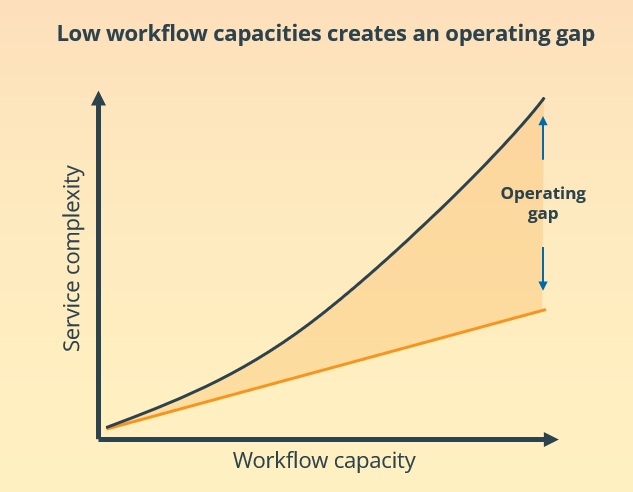
More systems. More stakeholders. More dependencies. Traditional workflows are reaching their limits.

Outcomes matter. Not tickets.

Customers want results. Businesses want faster, better and more transparent services.

Every decision comes at a cost.

What will the next action cost? What resources will it require? That needs to be clear beforehand, not after the fact.

AI needs more than intelligence.

AI agents can take action. But who makes sure they do the right thing?

The operational gap

Everything is getting more complex

More systems. More stakeholders. More dependencies. Traditional workflows are reaching their limits.

Outcomes matter. Not tickets.

Customers want results. Businesses want faster, better and more transparent

Every decision comes at a cost

What will the next action cost? What resources will it require? That needs to be clear beforehand, not after the fact.

AI needs more than intelligence

AI agents can take action. But who makes sure they do the right thing?
Test-image-service-operating-system - service complexity gap
financial-man-on-laptop-with-documents

Lots of data.
Lots of systems.
No complete picture.

Organizations have the knowledge, rules and cost data they need to make better decisions. The problem is that it is all in different places. A simple decision can quickly turn into a complex process, and decisions often remain a black box.

  • Knowledge: Is the information current, relevant and reliable?
  • Governance: Who can decide, approve or take action—even when AI is involved?
  • Financials: What costs and business impact will the next action have?
Serviceware logo

“For services to meet the demands of speed, cost efficiency and control amid growing complexity, an operating system must connect decisions and their execution directly to the process.”

Dirk Martin

CEO at Serviceware SE

dirk-martin-ceo-serviceware

The new operating system

What is an AI Service Operating System?

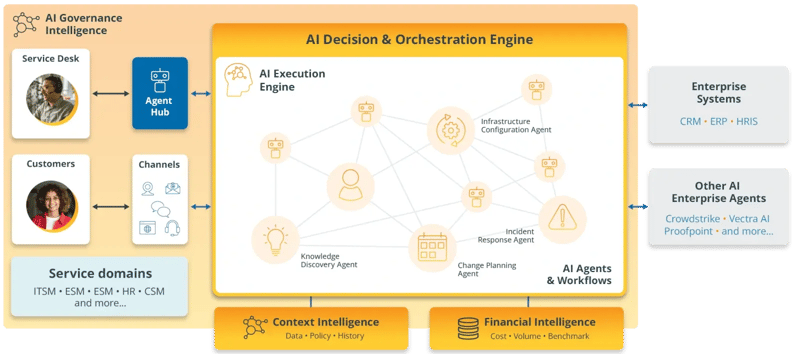
An AI Service Operating System is a platform-based operating system that connects service decisions with execution across teams and systems. It brings the knowledge, Financial Intelligence and AI governance needed into the process, so organizations can run, manage and continuously optimize their services.
  1. 1

    Decide

    What should happen? Decisions are based on goals, context and trade-offs.
  2. 2

    Orchestrate

    Coordinate work across teams, workflows, systems and AI agents.
  3. 3

    Execute

    Carry out service work in a controlled way across different domains.

Three foundations inform decisions

Context Intelligence: Understand what is happening

Service history, data, policies and relationships provide the operational context needed to make better service decisions.

Financial Intelligence: Understand costs and trade-offs

Financial Intelligence makes costs, capacity and demand visible where operational decisions are made. This helps assess the economics of a decision before it is put into action.

AI Governance Intelligence: Understand what AI is allowed to do

Roles, policies, approvals and traceability determine when AI assists, recommends or executes an approved action.

The vision

AI’s scope to act grows

AI’s scope to act grows only where data, controls and accountability can support it. Customers set their own level of ambition: they decide where to use AI and how much freedom it has to act.

Level 1: Assistive AI

AI supports employees with tools in their workplace.

Level 2: Workflow Agents

AI recommends or completes defined tasks within workflows.

Level 3: Integrated Agents

AI coordinates defined actions across systems and service domains.

Level 4: Governed Agentic Operations

AI carries out approved actions within established rules, controls and areas of responsibility.

Level 5: Autonomous Service Operations

AI continuously detects, decides and acts within defined guardrails and areas of responsibility.

How does the new operating system complement existing service processes?

Workflows remain essential for standardized service work. The AI Service Operating System embeds decisions, financial context and AI governance into the service process and connects them with execution.


AI on existing workflows

AI Service Operating System

Focus

AI supports predefined workflows. 

AI is embedded in the process and supports adaptive execution.

Scope

Decisions spanning multiple areas are often made outside the system—in emails or meetings, for example.

Decisions and execution are connected in the system across teams and service areas.

Context

Knowledge is often incomplete, and costs are not always visible before execution.

Operational and financial context is available before decisions are made and actions are carried out.

AI governance

It is often unclear what AI is allowed to recommend, decide or execute.

Roles, rules and approvals define what AI is allowed to recommend, decide or execute.

The AI-native Serviceware Platform

One platform for every service area

It provides the capabilities to run, manage and optimize modern enterprise services.

  • AI is embedded in the platform—not added on afterward.

  • AI Decision & Orchestration Engine

  • AI Execution Engine for AI Agents and Workflows

  • Context Intelligence, Financial Intelligence and AI Governance Intelligence
ai-native-platform-graphic

Serviceware Agent Hub

You set the goal. AI takes action. You stay in control.

Different goals. One shared platform.

consulting-senior-woman-with-tablet-speaking

COO - Service Operations

Turn decisions into impact faster.


  • • Less manual coordination
  • • Faster, adaptive services
  • • More resilient operations

financial-man-on-laptop-with-documents

CFO - Finance

See service costs before making a decision.


  • • Make costs efficiency visible
  • • Allocate costs more accurately
  • • Manage budgets more effectively

Woman leading a meeting in a modern office, gesturing while speaking as colleagues listen attentively

CIO - Enterprise IT

Scale automation safely.


  • • AExecute across systems
  • • Governed AI automation
  • • Less operational complexity

Serviceware as a „Strong Performer“

The Forrester Wave™: Enterprise Service Management Platforms, Q4 2025 compares 15 ESM providers worldwide.

“The vision is spot-on with what the industry needs and strongly links to transformation and innovation with AI advancements.”

Source: The Forrester Wave™: Enterprise Service Management Platforms, Q4 2025, Forrester Research, Inc.

Learn more
2511-report-forrester-wave-esm-q4-2025-square
reisebank-monochrome

“We don't want to keep opening tickets manually when processing can be automated. This isn't a future scenario, it's today's.”

Matthias Kreft

General Manager at Reisebank AG

matthias-kreft-reisebank-square
innsbruck-airport-monocolor

“ For us, it was crucial to be able to accurately map regulatory requirements within the system. Today, employees see precisely the information they need for their tasks. This creates transparency and supports us in implementing our compliance requirements.”

René Plattner

Flughafen Innsbruck

renee-plattner-flughafen-innsbruck

FAQ about the AI Service Operating System

An AI Service Operating System is an operating system for enterprise services. It connects decision-making and execution across teams and systems, while taking operational context, financial considerations and AI governance into account.

ITSM, ESM and other service processes organize specific workflows. The AI Service Operating System connects decisions, context and execution across these processes. Existing workflows remain part of the execution.

No. AI can assist with searches, recommendations, and defined actions. The powers it is granted depend on the specific use case, the data, and the applicable controls.

A first step is to analyze a specific service process: Where are the decision-making context, cost perspective, or governance missing? Based on this analysis, a suitable starting point can be identified.

Where does your AI service operating system stand today?

Choose the next step that best fits your starting point.

  • Assessment: Understand your current position and level of ambition

  • Demo: Experience the AI-native Serviceware Platform

  • Workshop: Plan a specific use case

Get in touch