Enterprise Service Management (ESM)
Enterprise Service Management — AI-Native for Better, Faster Services
When processes slow teams down, knowledge is scattered, and manual steps dominate, both speed and quality suffer across the entire service organization. An AI-native Enterprise Service Management platform brings workflows, data, and automation together in one system. The result: faster processes, better service experiences, and data-driven decisions. In short, everyday operations run more efficiently—creating the foundation for true service excellence.
The New Reality: Enterprise Service Management Goes AI-Native
Many organizations run their enterprise service management on a foundation that barely meets today's requirements. Departments like IT, HR, Facilities, and Finance still operate in siloed process logic—with separate tools, separate data, and separate workarounds. The result: service operations that react too slowly, invite errors, and waste resources. Under these conditions, service excellence remains out of reach.
Analysts identify this fragmentation as the root cause of performance and quality losses in service operations. Without data, priorities get misaligned. Without automation, speed suffers. And when knowledge is scattered, the reliability of answers and decisions declines.
At the same time, organizations increasingly classify service management as business-critical. Expectations for speed, transparency, and reliable self-service outcomes are rising faster than traditional enterprise service platforms can keep pace—especially in the AI era.
This is where the AI-native Serviceware Platform for enterprise service management comes in. It doesn't just replace old workflows—it elevates the entire service operation to a new performance level. Through integrated data, consistent workflows, and automation that's built into the platform architecture from day one, not added later. Creating the foundation for true service excellence—not just process management.
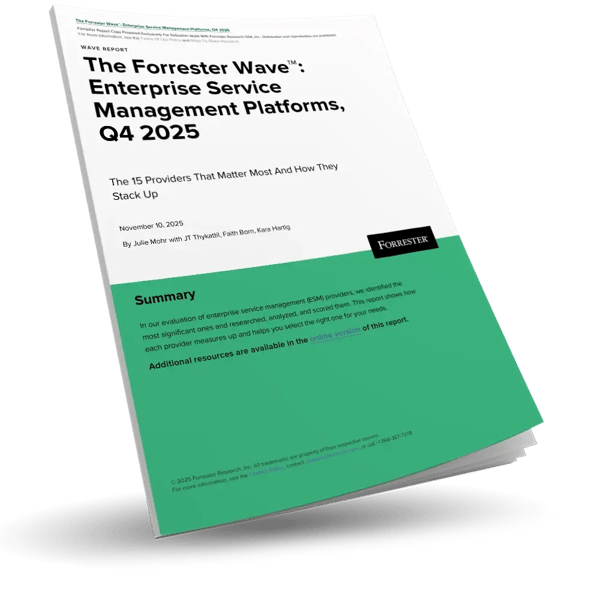
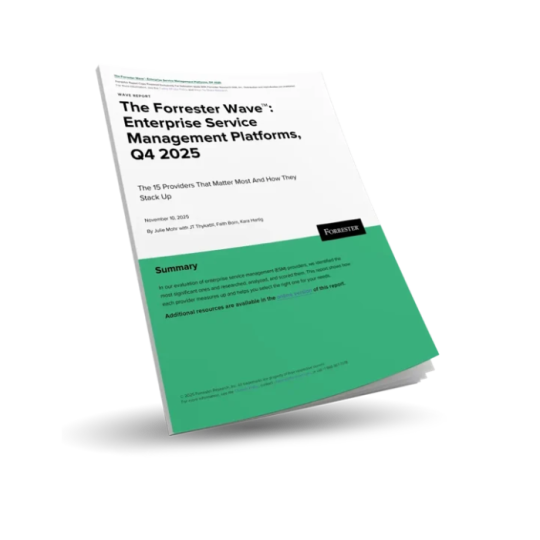
“Serviceware pursues a vision of intelligent, enterprise-wide service delivery through a truly AI-native approach. This aligns strongly with industry demand for transformation and innovation driven by AI advancements. For organizations seeking a platform focused on AI-supported incident management, knowledge management, and risk management, Serviceware is a good choice.”
Enterprise Service Management That Keeps Pace With the Business
Traditional service platforms manage processes—modern AI-native platforms continuously improve them. By connecting workflows, knowledge, analytics, and intelligent assistance, they create a service operation that responds faster, makes more accurate decisions, and delivers a significantly better service experience for employees and customers alike.
End-to-End Automation
Fragmented tools, media breaks, and manual handoffs slow service quality. With an AI-native process engine, workflows are harmonized, dynamized, and automated across departments. Operations get faster, more stable, and more efficient—freeing teams for value-adding work.
Agentic AI as the New Standard in Service Operations
Many processes stay reactive because decisions are made manually and data isn't consistently used. Agent-based AI analyzes context, identifies logical next steps, and executes actions directly in connected systems. Creating adaptive process chains that relieve teams and sustainably increase both speed and quality.
AI-Powered Process Design That Accelerates Change
Service teams lose time when workflows, forms, and data models require significant effort to adapt. AI-based design tools suggest new processes, objects, and layouts in natural language and make them immediately usable. Processes emerge faster, stay consistent, and support change instead of blocking it.
AI Assistance
In many organizations, information is scattered, tickets are incomplete, and decisions heavily dependent on individual expertise. AI assistance recognizes context, delivers relevant content, and suggests next steps. Processing gets faster, answers more precise—and results more reliable, regardless of who's on duty.
Knowledge Management as a Productivity Driver
Scattered knowledge leads to delays, long resolution paths, and unnecessary follow-up questions. AI-powered search, automatic text generation, and quality controls ensure teams can always access reliable, up-to-date information. Increasing first-time resolution rates and significantly reducing follow-ups and rework.
Self-Service That Delivers Results
Many self-service portals offer forms instead of solutions—shifting effort rather than reducing it. AI-powered interaction understands requests through portals, chat, or email in natural language and immediately delivers appropriate answers or triggers the right process. Requests get resolved faster, satisfaction increases—and ticket volumes drop measurably.
Service Catalog—Transparency Across All Services
Without a clearly structured service catalog, questions, inconsistencies, and delays emerge. A central, unified service catalog maps services transparently—including ownership, process steps, service level agreements (SLAs), and workflows. Creating orientation for all stakeholders, accelerating operations, and significantly reducing error rates.
Use Feedback—For Better Customer and Employee Experience
Feedback is often scattered, analysis is labor-intensive, and improvements are hard to derive. Integrated feedback mechanisms make service quality measurable and link feedback directly to processes. Bottlenecks become visible early, improvements are data-driven, and experiences for employees and customers are continuously optimized.
Analytics and Reports—Make Informed Decisions
Decisions are often based more on experience than on reliable data. Analytics and reporting capabilities link service KPIs with operational and financial metrics, providing insights into demand, resolution times, and satisfaction levels.
Patterns become visible, priorities clearer—and decisions truly data-driven.
Prompt Your Workflow: Create Workflows in Minutes, Not Projects—Try It Yourself
The Right Plan for Every Organization
Essential
- Service Desk
- Case Management
- Request Management
- Asset Management
- AI Assistant
- Self-Service Portal

Professional
- Service Desk
- Case Management
- Request Management
- Asset Management
- AI Assistant
- Self-Service Portal
- Survey
- Knowledge Base and Knowledge Publishing

Enterprise
- Service Desk
- Case Management
- Request Management
- Asset Management
- AI Assistant
- Self-Service Portal
- Survey
- Knowledge Base and Knowledge Publishing
- AI Chatbot
FAQs
Enterprise Service Management (ESM) describes the approach of systematically extending service processes, workflows, and knowledge structures from IT to other business areas. Instead of building isolated solutions for HR, facilities, finance, or procurement, all services are managed through a common model—with unified processes, clear ownership, and consistent standards. ESM creates an integrated service organization where operations function more consistently, information is centrally available, and teams work systematically with data, workflows, and automation. Modern ESM models leverage AI to further increase speed, quality, and transparency.
The Serviceware Platform is built on a fully AI-native architecture that unifies all service processes, workflows, and data on a common foundation. This means AI wasn't integrated later—it's been part of the platform concept from day one, including Agentic AI, native automation engine, integrated knowledge management, and open interfaces. Organizations benefit from high consistency, minimal integration effort, and the ability to deploy new services faster than with traditional system landscapes.
Further informationServiceware uses open REST APIs, standard connectors, and flexible integration patterns. Systems like Microsoft Teams, HR tools, IT monitoring, identity management solutions, ERP systems, and security stacks integrate seamlessly. The platform orchestrates workflows both within its own modules and across external systems. This means organizations don't need to replace existing tools or migrate data to benefit from AI-powered automation. The Serviceware ESM platform complements existing system landscapes—it doesn't replace them.
Yes. Many organizations begin with a clearly defined area like IT service management or HR service management, then gradually expand into additional service domains. The platform is modular, so capabilities, workflows, or AI assistants can be added anytime. This makes Serviceware suitable both for companies taking their first steps toward enterprise service management and for organizations already operating complex service portfolios looking to consolidate or modernize them.
IT Service Management (ITSM) focuses on delivering, managing, and quality-assuring IT services. Enterprise Service Management (ESM) goes further: it extends the established principles, processes, and standards of ITSM to other business areas like HR, facilities, finance, or procurement. This creates a unified service operating model that works across departments—with shared workflows, clear ownership, and consistent service experiences for the entire organization.