

IT Global Business Services
Standardize, Scale, and Succeed With IT Shared Services
Standardize how IT shared services run, how costs flow, and how value shows up. Serviceware Financial centralizes shared services, boosts quality, and cuts waste, on one platform.

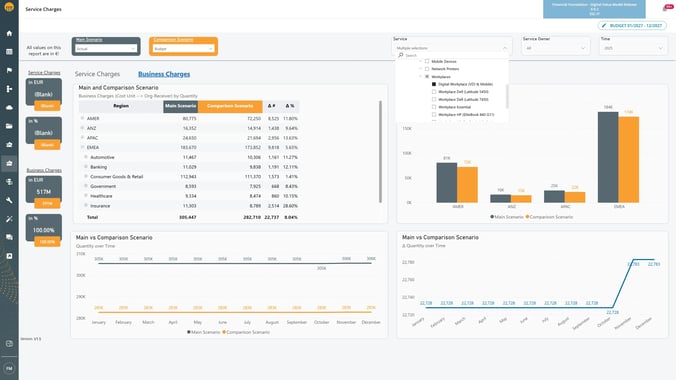





“With Serviceware Financial, you can quickly create scenarios and prepare decision templates. This way, we offer customers the highest degree of transparency regarding the services they purchase and enable them to influence their costs.”
Hannes Mackowiak
Senior IT Controller at SWE Digital GmbH



“By using Serviceware Financial, I effectively have more IT budget available!”
Head of IT Service Management at ZF Friedrichshafen









Taking IT Shared Services from Centralized to Standardized


Cost: Centralize and standardize to remove waste and unlock scale.
Quality: Define services, measure SLAs, and raise reliability.
Efficiency: Automate allocations and billing to shorten cycles.
Governance: One model across IT, Finance, and operations.
Integrations




See IT Shared Global Business Services Maturity In Practice

ITFM Resources




Frequently Asked Questions
GBS spans multiple functions (e.g., IT, finance, HR) under one governance model; SSCs typically focus on one function. Serviceware supports both. GBS spans multiple functions (e.g., IT, finance, HR) under one governance model; SSCs typically focus on one function. Serviceware supports both.
It’s shifting from cost cutting to a strategic partner—owning quality, transparency, and measurable outcomes.
Define services, SLAs, and KPIs once; use the shared model across IT, Finance, and operations. Track performance in one place.
Automation, integration with ERP/ITSM/HR systems, and analytics. Serviceware centralizes data and automates allocations and billing.
Standardize request types and rules; route, allocate, and bill automatically where appropriate.
Track service TCO, SLA attainment, allocation accuracy, dispute rate, and cycle times for planning, forecasting, and billing.
Typical programs start with a defined service catalog and key integrations, then phase to planning and billing—weeks, not quarters.