


Quick answer
An IT chargeback model assigns technology costs to the business units, products/apps, platforms, or services that drive them. It connects IT spending to business unit demand using cost pools, allocation drivers, and unit costs - and (when needed) converts unit costs into published rates using transparent pricing rules. Done well, chargeback improves accountability, supports planning, and creates a shared CIO-CFO view of technology economics.
Introduction
Chargeback has a reputation. Some see it as a cost-recovery mechanism. Others describe it as an internal tax. In reality, when designed with transparency and fairness, chargeback becomes the governance backbone of how IT demonstrates value, manages demand, and creates shared accountability across the business.
The modern IT chargeback model is a financial operating system: mapping usage to services, connecting cost structures to consumption, and helping business leaders understand the economic impact of digital decisions.
To build a model that works (and that Finance, IT, and the business all trust) you need three things.
-
A clear definition of what you’re charging for
-
A reliable way to calculate unit costs
-
Pricing rules that reflect both technology reality and business purpose
This guide breaks down exactly how to do that.
What is an IT chargeback model?
An IT chargeback model is the financial framework for assigning IT costs to cost objects that drive demand - such as business units, product/apps, platforms, or services. It uses cost pools, allocation drivers, and consumption metrics to calculate unit costs, then applies pricing policies to produce rates that are understandable, predictable, and auditable.
As CIO.com points out, poor cost transparency is one of the recurring weaknesses in IT management. Chargeback closes that gap by giving every business unit a clear line of sight into what they use and what it costs.
A chargeback model typically includes:
- A defined set of chargeable cost objects (service/product/app) with units of measure A service catalogue with clearly defined units of measure
- Unit cost calculations based on allocation and consumption data
- Pricing policies (flat, tiered, usage-based, or hybrid; plus subsidies/buffers if applicable)
- A billing cadence and workflow (showback/chargeback outputs and approvals)
Its purpose is: traceability, predictability, and and alignment between demand and spend.
How IT chargeback works
Chargeback translates the cost of IT into a service-based pricing model.
It works in five steps:
1. Define the services you want to charge for
These might be end-user services, infrastructure, applications, cloud resources, or cross-functional capabilities. The key is clarity. Every service must have a defined scope and unit of measure.
2. Allocate IT spend into cost pools
Start with financial sources (GL/ERP, invoices, cloud bills) and group costs into logical pools (e.g., end-users, applications, compute, storage, network, service desk, security). TBM taxonomies can help standardize these pools and towers; FinOps data helps validate what’s actually driving variable consumption.
3. Select drivers and calculate unit costs
Once drivers are defined (users, devices, tickets, GB, VM-hours, etc.), unit costs is straightforward:
Unit Cost = Total Allocated Cost ÷ Total Units Consumed
For example:
If a storage service costs $600,000 a year to run, and the organization consumes 3,000 TB of storage, then:
$600,000 ÷ 3,000 TB = $200 per TB
That figure becomes the unit rate used in showback or chargeback.
This is where driver-based planning and rolling forecasts keep pricing accurate. The more precisely you track cost and consumption, the more defensible your unit rates become.
4. Convert unit cost into a pricing rule
Decide whether you will charge pure cost or apply policy: tiering, caps, subsidized services, minimums, or blended “fixed + variable” recovery. Make policy explicit—otherwise, stakeholders will assume the numbers are arbitrary.
5. Automate billing workflows
A chargeback model only works if billing is consistent.
IT chargeback models: the main options
There is no single “best” chargeback model…only the one that fits your maturity, culture, and data quality. Before choosing a chargeback model, decide whether you are doing showback (informational) or chargeback (posted to budgets/P&L). Many organizations use showback first to build trust; chargeback depends on accounting policy.
Here are the four dominant models:
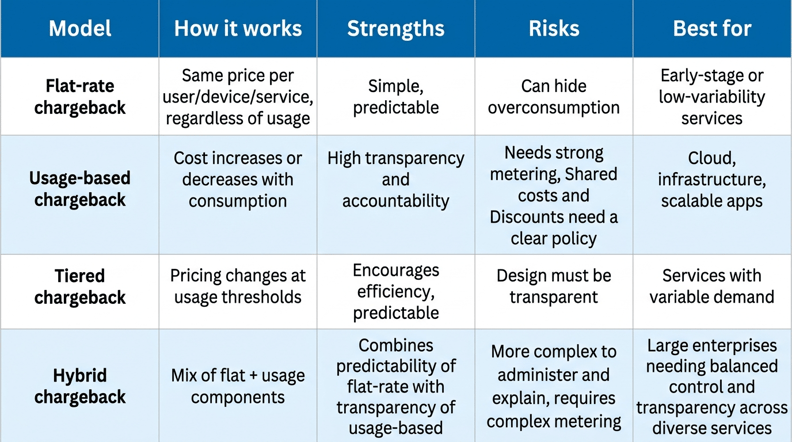
Choosing the right model: a decision matrix
When flat-rate makes sense
If the service is stable, predictable, and consumed uniformly (e.g., Office 365, endpoints, collaboration tools), flat-rate pricing reduces noise and simplifies budgeting.
When usage-based is strongly preferred
Cloud infrastructure, storage and network costs are inherently variable. Usage-based or hybrid pricing is usually the most defensible - especially when teams have real levers to change consumption.
When tiered pricing helps behavior
Tiered models work when you want predictable cost brackets, encouraging optimization without destabilizing budgets.
When hybrid is the right compromise
Hybrid models fit complex environments where you want to recover fixed cost (flat rate) but charge for variable usage (e.g., cloud, VMs, backup volume).
How to price an IT chargeback model
Pricing should reflect cost, consumption, and policy. Here’s how to build rates that stand up to scrutiny:
1. Start with fully loaded unit costs
Include labor, licenses, depreciation, vendor contracts, overhead, platform services, and shared infrastructure.
2. Decide whether you want pure cost or policy-based pricing
Options include:
- Pure cost rate
- Cost + buffer (contingency)
- Cost minus subsidy (strategic investment)
- Tiered or seasonal policies
3. Validate rates with Finance
Decide the rate stability model: fixed annual/quarterly rates with periodic true-ups, or rolling rates for showback. Predictability matters as much as precision.
4. Stress-test against historical demand
Ask: would this model have discouraged overconsumption last year? If not, the pricing model isn’t working hard enough.
5. Publish prices in the service catalogue
The service catalogue becomes the single source of truth for what IT offers, what it costs, and how it’s billed.
Rolling out a chargeback model that works
Chargeback succeeds or fails on trust - ollout often matters more than math.
A common (and low-risk) sequence is:
-
Start with showback to valide drivers, fix data quality and build explainability.
-
Communicate early: how rates are build, what changes tehm, and what teams can control.
-
Pilot one or two services (one stable, one variable) before scaling.
-
Automate the workflow so invoices are consistent and auditable.
-
Run feedback loops with service owners and Finance to tune drivers and policy.
Common mistakes to avoid
The failures are predictable… and avoidable.
Mistake 1: Showback first. Always.
Showback first is often the safest way to build acceptance—but if your accounting policy requires chargeback immediately, you’ll need extra governance and communication.”
Mistake 2: Rates that don’t reflect real drivers
If the pricing model ignores driver behavior, consumption won’t change.
Mistake 3: Overcomplicating the catalogue
A bloated catalogue kills adoption. Start simple.
Mistake 4: Chargeback is political. Go slow.
Chargeback is a change-management exercise. Move at the speed your data quality and governance can support.
Mistake 5: Treating chargeback as an IT project
Chargeback is a Finance-IT operating model, not a billing mechanism.
To sum up
Chargeback works when it’s clear, explainable, and tied to real drivers. When stakeholders can trace a rate to cost pools, drivers, and policy, conversations shift from invoice disputes to demand decisions. IT gains transparency, Finance gains planning confidence, and business units gain controllable levers.
With solid cost pools, clean drivers, defensible unit rates, and automated billing through our ITFM Solution, chargeback stops being a political minefield and becomes a practical operating model. It turns IT from a cost center into a service provider with value, real choices, and real financial clarity.
Get chargeback right, and everything else gets easier, forecasting, budgeting, service pricing, and every CIO–CFO conversation after it. Book your free demo today.

Book your free demo today
Get startedFAQs
1. What is an IT chargeback model?
A structured way to allocate IT costs to the business units that consume services, using cost pools, unit rates, and transparent pricing rules.
2. How is IT chargeback different from showback?
Showback reports usage and cost to stakeholders for visibility. Chargeback formally assigns those costs to budgets/P&L. The difference is the accounting formality, not “maturity.”
3. What data do I need to build a chargeback model?
GL/ERP costs, a cost pool structure, allocation drivers, usage/consumption metrics, defined cost objects (service/product/app), and pricing policy. Tooling helps automate and audit the workflow, but the model design comes first.
4. How do unit costs affect chargeback pricing?
Unit costs determine the baseline price for each service. Forecasting and driver-based planning refine these prices over time.
5. Should every IT service be charged back?
No. Strategic or corporate-wide services (security, ERP, networking) are often centrally funded or showback-only.
6. How do I automate IT chargeback?
Use a platform like Serviceware for Charging & Billing of IT to automate allocation, pricing, approvals, and billing entries.


