


Roles, responsibilities, the 7 R's, and the differences between ITIL v3, v4, and v5 — everything IT service management pros need to run change with confidence.
Contents:
- What is IT change management?
- The core elements of IT change management
- How to implement IT change management in your organization
- Making it stick: Organizational change management (OCM)
- How change management has evolved within ITIL
- ITIL v3 vs. v4 vs. v5: What actually changed?
- Best practices and pitfalls
- Key success factors
- Real-world examples
What is IT Change Management?
Every IT change — from swapping out a workstation to migrating to the cloud — carries risk. Without a structured process, even minor updates can spiral into outages, service degradation, or security gaps. IT change management gives you the guardrails to execute changes in a controlled, repeatable way: minimizing risk, protecting service continuity, and ensuring that nothing goes live without the right people knowing about it.
The Core Elements of IT Change Management
IT change management centers on seven questions — the "7 R's" — that every change request needs to answer before it moves forward. These aren't bureaucratic checkboxes. They're the difference between a change that gets approved and implemented cleanly, and one that gets stuck in review limbo or, worse, causes a production incident.
1. Who raised the change request?
In large organizations with multiple departments and stakeholders, ad hoc change requests are a recipe for chaos. Start here: Where is this request coming from? Who owns the requirement? Who do you go to when you need answers? Documenting this systematically is the foundation of structured change management.
2. What is the reason for the change?
Why are we doing this? A technically sound solution is worthless if it's solving the wrong problem. Change requests often arrive pre-packaged with a proposed solution — which can blind you to a better one. Getting clarity on the why lets you weigh opportunities against risks properly and prioritize accordingly. High-risk changes with minimal business value should never make it through. A 2x2 prioritization matrix — plotting impact (number of affected users and systems) against urgency — works well here, similar to how you'd triage incidents.
3. What is the expected return?
Nobody can predict the future, but every change request needs a projected benefit — something concrete you can evaluate against afterward. Not every change translates directly into customer-facing value. Automating a tedious manual process might free up your dev team for innovation. Automated regression and load testing reduces support burden. Paying down technical debt keeps your environment agile. Wherever possible, translate these soft factors into hard metrics — cost, capacity, time — so you can prioritize with data, not intuition.
4. What risks does this change carry?
Every IT change introduces risk. Identify it early. The usual suspects: service disruptions from downtime or performance issues, unintended cascade effects from system dependencies, misconfiguration or integration failures, and security vulnerabilities when new technologies or APIs are introduced. The key thing to understand: changes rarely operate in isolation. Even a small tweak can ripple across services, processes, and user groups in ways that aren't immediately obvious. Model the consequences before you commit.
5. What resources does this change require?
At the macro level, it's always time and money. At the operational level, it's people (skills) and systems (capabilities) — neither of which exists in a vacuum. Committing resources to one initiative means pulling them from another. Can you run both in parallel? What delays does that create elsewhere? And this question doesn't stop at your internal IT org — it extends across the entire value chain, including downstream impact on customers. Resource constraints need to factor into change prioritization.
6. Who is responsible for the build, test, and deployment?
Usually, these are different people — sometimes different teams or departments entirely. That makes clear ownership non-negotiable. When everyone knows exactly who's responsible for what, accountability is enforceable and blame-shifting becomes a non-issue if something goes wrong. Responsibility must be visible and unambiguous across the full change and release management lifecycle.
7. How does this change relate to other changes in flight?
IT environments are deeply interconnected. Some changes depend on others as prerequisites. Some create risks for work happening in parallel. In an ideal world, you're working from a Configuration Management Database (CMDB) that maps these dependencies explicitly — enabling coordinated scheduling that minimizes downtime and sequencing conflicts. Where a full CMDB isn't available, work with subject matter experts, leverage monitoring and asset data, and mine institutional knowledge from previous changes. The tool matters less than the visibility. Without it, you can't coordinate changes safely.
How to Implement IT Change Management in Your Organization
Effective implementation starts with an honest assessment of where you are today and a clear picture of where you need to be. From there, you build a change timeline and validate through a testing model before anything goes live.
Service management tooling for consistent ITSM processes
This process gets significantly more manageable with the right ITSM platform behind it. A capable service management tool should deliver:
- Stronger process control through a tool-based Forward Schedule of Change (FSC), cross-organizational calendar planning, comprehensive resource management, and clear governance of change roles and responsibilities
- Role-based access tied to your enterprise LDAP system for all process activities
- Dependency and impact visibility across your IT infrastructure — ideally through a native or integrated CMDB
- End-to-end transparency across all change and release management activity, from initial request through post-implementation review
- Full documentation of all change and release management activity within the tool, based on your Asset & Configuration Management Database (CMDB) — native or integrated
- Clear, automated communication at every stage of the change process
- Robust risk management to support effective Change Advisory Board (CAB) decisions — especially for emergency changes evaluated in the eCAB
- KPI tracking and reporting with minimal manual overhead
- Streamlined ITIL change management workflows
The right ITSM tool doesn't just support your change process — it makes it significantly more effective.
Making It Stick: Organizational Change Management (OCM)
Once a change is live, the work isn't over. A thorough post-implementation review should evaluate: Were the objectives met? Was the timeline honored? What should be done differently next time? Assigning a dedicated change manager to oversee and continuously improve the ITSM program makes this review systematic rather than ad hoc.
People are part of the process
Technology is only half the equation. Service management doesn't happen in a vacuum — it happens inside organizations with established cultures, entrenched workflows, and competing interests. Changes disrupt existing routines and responsibilities, and that creates uncertainty, resistance, and sometimes political friction.
Modern service management frameworks acknowledge this directly. ITIL 4 deliberately shifted the emphasis away from rigid processes toward value creation, collaboration, and adaptability. The next evolution — often called ITIL 5 — goes further: it describes a model oriented around governance, automation, and data-driven decision-making.
As AI and automation become more deeply embedded in service management, the human role continues to shift — from executing tasks to overseeing systems, making judgment calls, and driving continuous improvement.
How Change Management Has Evolved Within ITIL
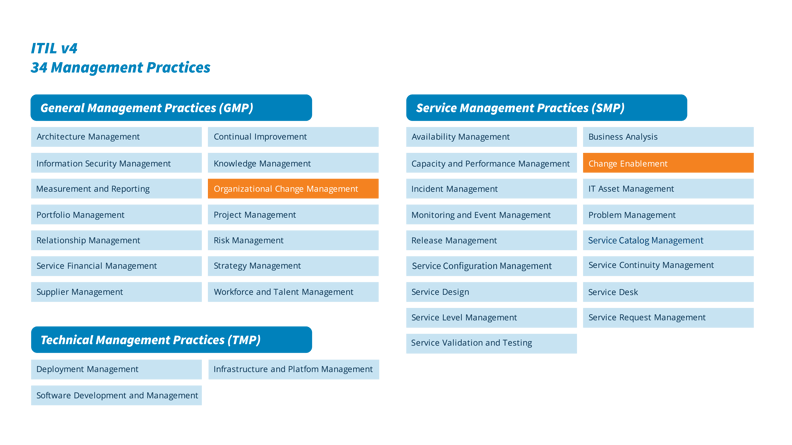
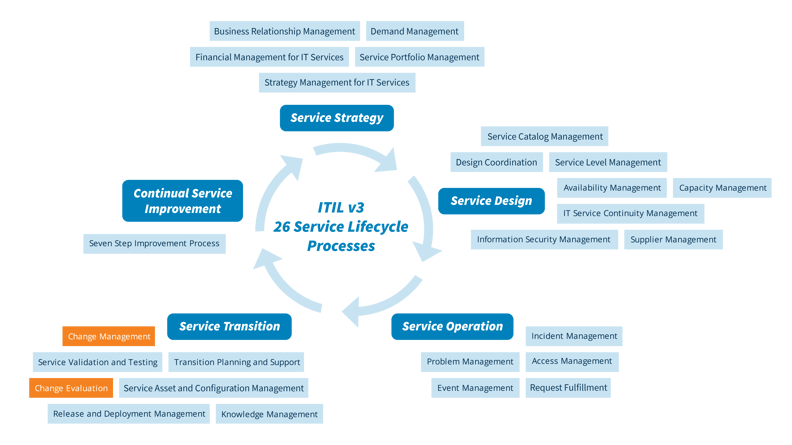
ITIL v3 treated change management as a structured, process-oriented component of Service Transition — with a strong focus on control, standardization, and risk reduction.
ITIL v4 reframed it as a flexible service management practice called "Change Enablement" and embedded it more deeply into the end-to-end service value chain. The emphasis shifted from rigid workflows to adaptability, speed, and value contribution.
The next evolution — commonly referred to as ITIL 5 — isn't a new rulebook. It represents a shift toward a data- and AI-driven governance model. Changes are no longer managed purely through sequential planning and execution. Instead, they're increasingly handled in a context-aware, predictive, and partially automated way. The focus moves beyond safely executing changes to actively shaping service delivery, value streams, and business impact on an ongoing basis.
ITIL v3 vs. v4 vs. v5: What Actually Changed?
ITIL v3 and v4 remain the operational reality for most IT organizations today. Both frameworks underpin the processes, roles, and structures running in production environments right now. ITIL v5 is still emerging, so the comparison below focuses on the two established versions you're most likely working with.
ITIL v3 |
ITIL v4 |
| Describes change management as a process in service transition. | Describes change management as a service management practice and calls it change enablement. ITIL v4 lists the basic activities in change enablement as well as the key inputs, outputs and roles. (IT) organizations can use these guidelines to design a customized process for managing changes that reflect their individual requirements. |
Process steps:
|
Change enablement practice: The change management process according to ITIL v3 does not become obsolete and can be used as a template for individual adaptation in the IT organization.
|
| Focus on service transition and deployment |
Focus on the service value chain including the design and development phase Change enablement should be designed to keep the end-to-end service management value chain in mind. An iterative approach is designed to balance rapid implementation of an RfC on the one hand with managing the associated risks to existing services on the other. |
Best Practices and Pitfalls: A Real-World Example
Here's what a breakdown — and recovery — looks like in practice. Following a serious IT outage, the IT Director of a mid-sized company was tasked with overhauling the change management process. His priority: risk management — one of the seven core requirements in ITIL change management.
What triggered the incident
A minor hardware change in a regional branch office. What started small cascaded across the organization, eventually taking down communications and video systems company-wide. Remote employees were cut off. Executive meetings with customers and suppliers couldn't happen. It took IT three hours to restore essential business operations.
As an ITIL expert and change management process owner, the IT Director eventually pieced together the full picture of what had gone wrong.
A root cause analysis had been completed. A post-implementation review had not. The branch office change had never been submitted through the change process, and it hadn't been executed by a qualified, authorized person.
Where risk management failed
The change management process had specific risk management steps — designed precisely to prevent this kind of outage. Two years earlier, the IT Director and IT Change Manager had written a policy that codified ITIL change management best practices for their environment. Teams had been trained on it regularly. None of it mattered — because none of it had been followed.
Key Success Factors in IT Change Management
Change only works when people understand why it's happening and believe it can succeed. Establishing that clarity and confidence was the IT Director's biggest challenge.
The case for preventing another communications outage didn't require much selling. Nobody wants process failures, service disruptions, or escalations. Straightforward, well-documented workflows with clear ownership and disciplined risk management — that's something everyone who cares about a stable, high-performing IT environment can get behind.
Requirements list for the new ITSM tool
-
Highlight the importance of an integrated Asset & Configuration Management Database and connect it explicitly to the recent incident
-
Extend the RFI criteria beyond purely process-oriented and system-level functionality
-
Weight features that enable transparency and automation — and eliminate manual routine work — more heavily
-
Prioritize ease of use across devices and channels
Only then, he was convinced, would colleagues actually embrace the changes. Only then could the new change management process be activated quickly. And only under those conditions could they reliably optimize systems, improve processes, and prevent major outages going forward — driving toward better business outcomes and real progress on digital transformation.
Real-World Examples
Lufthansa (2023)
A February 2023 IT outage at Lufthansa caused significant disruption to flight operations. A damaged data cable took down critical systems including check-in and boarding. Thousands of passengers were affected; flights were canceled or rerouted. The incident exposed how dangerous single points of failure and missing redundancy can be in complex IT environments.
(Source: ADAC)
Deutsche Bank / Postbank (2023)
The migration of Postbank systems onto Deutsche Bank infrastructure in 2023 caused severe service disruptions for customers. Many were temporarily unable to access their accounts or complete transactions. Problems persisted for weeks, eroding customer trust significantly. The migration illustrated the risks of large-scale system transitions without adequate stabilization during live operation.
(Source: Der Spiegel)

Implement IT Change Management Professionally
Our Serviceware experts support you in implementing your specific requirements.
Book your ITSM demo

