2026 Joint Benchmarking Initiative by Serviceware & McKinsey
Benchmark Your IT Costs Against Relevant Peers
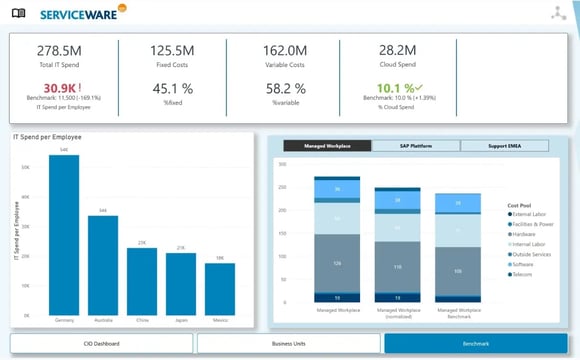
Compare your IT budget, service costs, run/change investment, and cost structure with organizations like yours. Receive decision-ready insights that help you identify optimization opportunities, support budget planning, and demonstrate where IT is already creating value.



Continuous Internal Benchmarking
- Compare business units, services, vendors, and regions
- Identify internal cost outliers and optimization opportunities
- Measure the impact of optimization initiatives over time
- Support operational and financial decisions throughout the year

Annual External Benchmarking
- Compare your IT organization with relevant peer organizations
- Validate your cost position against market benchmarks
- Gain an independent external perspective on IT spending
- Support annual budget planning and strategic investment decisions


Serviceware’s 2025 ITFM Trend Report shows that improving financial visibility can reduce cost-related queries by 95%; yet most CIOs still struggle to integrate vendor and contract data across the enterprise.
Read the reportWhat will you learn from the 2026 IT Benchmark?
The 2026 Joint Benchmarking Initiative helps you answer the questions that matter most when planning your IT budget, evaluating cost efficiency, and prioritizing future investments.
Are our IT costs competitive?
Compare your overall IT budget, service costs, and spending profile with relevant peer organizations to understand where your costs align with the market, and where they don't.
Are we balancing run and change investment effectively?
Benchmark your run/change investment profile to see how your spending compares with organizations balancing operational stability and future growth.
Which costs should we investigate first?
Identify IT towers, services, and cost categories that differ from peers, helping you focus analysis where it can have the greatest impact.
Where is IT already performing well?
Validate areas where your IT organization is cost-efficient and use objective benchmark data to support discussions with finance, business stakeholders, and executive leadership.
Where should we optimize, defend, or reinvest?
Receive a Benchmark-to-IT-Value report with actionable optimization hypotheses to support budgeting, procurement, vendor negotiations, and technology strategy.



-
Understand where costs differ
Compare business units, services, vendors, and regions to identify cost outliers and opportunities for improvement.
-
Build complete cost transparency
Create a standardized IT cost model that reveals the full cost of delivering IT services.
-
Support better sourcing decisions
Compare vendor costs using objective data to strengthen procurement and contract negotiations.
-
Turn benchmark insights into action
Use benchmarking to support budgeting, forecasting, and technology investment decisions.
-
Measure progress over time
Track the impact of optimization initiatives using continuous internal benchmarking.


“With Serviceware we standardized metrics for costs and expenses in order to compare our performance with other market players, now being able to deliver more value to the business.”
Relationship Manager, Procurement & Supply Chain at Petrobras


Talk to a benchmarking expert
What to expect
Participating in the benchmark typically requires 1–3 days using a standardized data collection approach.
You'll receive:
- Benchmark analysis
- Peer comparison
- Benchmark-to-IT-Value report
- Optimization hypotheses
- Executive review of the results
What happens next?
After you submit the form, Dr. Christopher Boortz or a member of the benchmarking team will contact you to discuss your objectives, explain the benchmarking approach, and answer any questions before participation begins.